12. Stereotactic Craniotomy
At 6:00 am on the morning of December 27, 1996, flanked on either side by G.G. and Kelly, I marched into Massachusetts General Hospital to have my head cut open. When I think about courage, I think about that morning.
I have had long blonde hair since I was a little girl. The last thing I remember saying to Dr. Ogilvy before he injected me with some meds was, "Hey doc, I'm 37 and single; please don't leave me totally bald!" On that note, he knocked me out.
G.G. and Kelly were quite upset with how long surgery lasted. It was late in the afternoon before word finally got to them that I was in the recovery room. Upon awakening, I realized that I felt different now. There was brightness in my spirit again and I felt happy. Up to this point, my emotions had been relatively flat. I had been observing the world, but not really engaging with it emotionally. I had missed my childlike enthusiasm since the hemorrhage and was relieved to feel like "me" again. I knew that whatever the future now held, I could face it with joy in my heart and I would be all right.
Shortly after awakening from surgery, I discovered that the left third of my head had been shaved. A nine inch upside down "U" shaped scar - running three inches up in front of my ear, three inches horizontally over my ear and three inches down behind my ear, was covered with an enormous patch of gauze. How nice of the good doctor to leave the right half of my head covered with hair. The moment G.G. arrived at my bedside she blurted, "Say something!" Her greatest fear, of course, was whether or not the surgeons had to take some of my language center neurons rendering me mute. I was able to speak to her softly. We both welled up in tears. The surgery had been an absolute success.
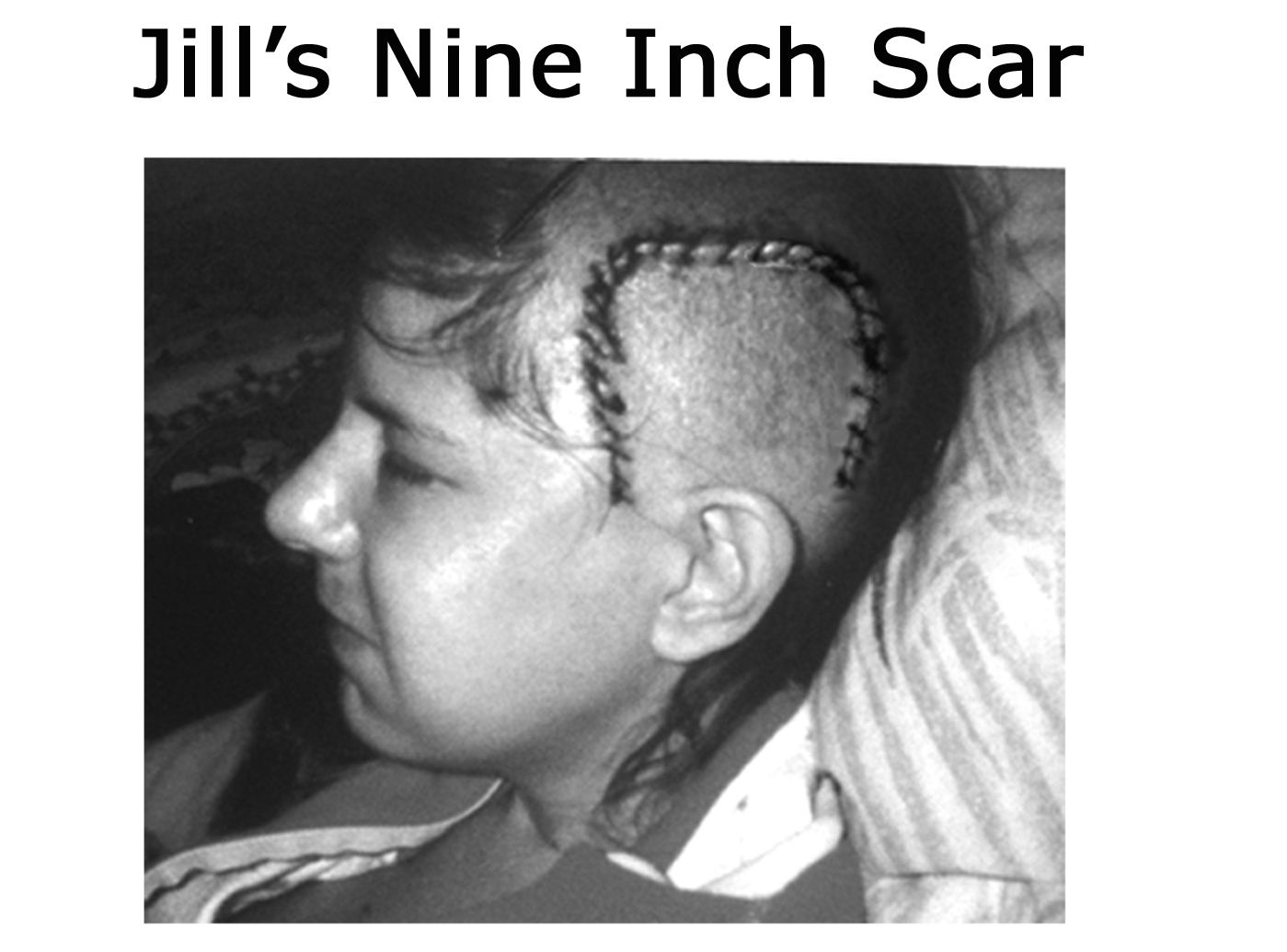
After the surgery, I stayed in the hospital for the next five days. For the first 48 hours, I begged to have bags of ice applied to my head. I don't know why, but my brain felt as though it were on fire and the cold ice relieved the intense heat so I could sleep.
My last night in the hospital was New Year's Eve. In the middle of the night, I sat up in the window, all alone, watching the lights of downtown Boston. I wondered what the new year would bring. I pondered the irony of my experience - a brain scientist having a stroke. I celebrated the joy I felt and the lessons I had learned. I was touched by the daunting reality: I was a stroke survivor.
Please note that I have created a list of "Recommendations for Recovery” as a synopsis of this chapter's comments and recommendations for how I needed to be assessed and what I needed the most to recover. This list is located in Appendix B and is available for your personal use.
Recovery was a decision I had to make a million times a day. Was I willing to put forth the effort to try ? Was I willing to momentarily leave my newly found ecstatic bliss to try to understand or reengage with something in the external world? Bottom line, was I willing to endure the agony of recovery? At this level of information processing, I was well aware of the difference between that which gave me pain versus that which gave me pleasure. Being out in the la-la land of my right hemisphere was enticing and wonderful. Trying to engage my analytical left mind was painful. Because it was a conscious decision for me to try, it was critically important that I be surrounded by competent and attentive caregivers. Otherwise, frankly, I probably would not have bothered to make the effort.
In order for me to choose the chaos of recovery over the peaceful tranquility of the divine bliss that I had found in the absence of the judgment of my left mind, I had to reframe my perspective from "Why do I have to go back?" to "Why did I get to come to this place of silence?" I realized that the blessing I had received from this experience was the knowledge that deep internal peace is accessible to anyone at any time. I believe the experience of Nirvana exists in the consciousness of our right hemisphere, and that at any moment, we can choose to hook into that part of our brain. With this awareness, I became excited about what a difference my recovery could make in the lives of others - not just those who were recovering from a brain trauma, but everyone with a brain! I imagined the world filled with happy and peaceful people and I became motivated to endure the agony I would have to face in the name of recovery. My stroke of insight would be: peace is only a thought away, and all we have to do to access it is silence the voice of our dominating left mind.
Recovery, however you define it, is not something you do alone, and my recovery was completely influenced by everyone around me. I desperately needed people to treat me as though I would recover completely. Regardless of whether it would take three months, two years, 20 years, or a lifetime, I needed people to have faith in my continued ability to learn, heal, and grow. The brain is a marvelously dynamic and ever-changing organ. My brain was thrilled with new stimulation, and when balanced with an adequate amount of sleep, it was capable of miraculous healing.
I have heard doctors say, "If you don't have your abilities back by six months after your stroke, then you won't get them back!" Believe me, this is not true. I noticed significant improvement in my brain's ability to learn and function for eight full years post-stroke, at which point I decided my mind and body were totally recovered. Scientists are well aware that the brain has tremendous ability to change its connections based upon its incoming stimulation. This "plasticity" of the brain underlies its ability to recover lost function.
I think of the brain as a playground filled with lots of little children. All of these children are eager to please you and make you happy. (What? You think I'm confusing children with puppies?) You look at the playground and note a group of kids playing kickball, another group acting like monkeys on the jungle gym, and another group hanging out by the sand box. Each of these groups of children are doing different yet similar things, very much like the different sets of cells in the brain. If you remove the jungle gym, then those kids are not going to just go away, they are going to mingle with other kids and start doing whatever else is available to be done. The same is true for neurons. If you wipe out a neuron's genetically programmed function, then those cells will either die from lack of stimulation or they will find something new to do. For example, in the case of vision, if you put a patch over one eye, blocking visual stimulation coming into the cells of the visual cortex, then those cells will reach out to the adjacent cells to see if they can contribute their efforts toward a new function. I needed the people around me to believe in the plasticity of my brain and its ability to grow, learn, and recover.
When it comes to the physical healing of cells, I cannot stress enough the value of getting plenty of sleep. I truly believe that the brain is the ultimate authority on what it needs to heal itself. As I mentioned earlier, for my brain, sleep was "filing time." While awake, energy stimulation poured into my sensory systems and I was rapidly burned out by photons stimulating my retinal cells and sound waves beating chaotically on my tympanic membrane. My neurons could not keep up with the demand and quickly became incapable of making sense of any incoming information. At the most elementary level of information processing, stimulation is energy, and my brain needed to be protected, and isolated from obnoxious sensory stimulation, which it perceived as noise.
Over the course of several years, if I didn't respect my brain's need for sleep, my sensory systems experienced agonizing pain and I became psychologically and physically depleted. I firmly believe that if I had been placed in a conventional rehabilitation center where I was forced to stay awake with a TV in my face, alert on Ritalin, and subjected to rehab on someone else's schedule, I would have chosen to zone out more and try less. For my recovery, it was critical that we honor the healing power of sleep . I know various methodologies are practiced at rehabilitation facilities around the country, yet I remain a very loud advocate for the benefits of sleep, sleep, sleep, and more sleep interspersed with periods of learning and cognitive challenge.
From the beginning, it was vitally important that my caregivers permit me the freedom to let go of my past accomplishments so I could identify new areas of interest. I needed people to love me - not for the person I had been, but for who I might now become. When my old familiar left hemisphere released its inhibitions over my more artistic and musically creative right hemisphere, everything shifted and I needed my family, friends, and colleagues to support my efforts at re-inventing myself. At the essence of my soul, I was the same spirit they loved. But because of the trauma, my brain circuitry was different now, and with that came a shifted perception of the world. Although I looked the same and would eventually walk and talk the same as I did before the stroke, my brain wiring was different now, as were many of my interests, likes, and dislikes.
My mind was so impaired. I remember thinking, Can they take away my Ph.D. ? I don't remember any anatomy! I knew that I would have to find a new career that was amenable to my newly found right hemisphere gifts. Since I had always loved gardening and lawn care, I considered this a viable future option. I desperately needed people to accept me as the person I was at that moment, and permit me the freedom to evolve as a right hemisphere dominant personality. I needed those around me to be encouraging. I needed to know that I still had value. I needed to have dreams to work toward.
As I stated earlier, G.G. and I inherently understood that it was essential that we challenge my brain systems immediately. Connections in my brain had been broken and it was crucial that we restimulate them before they either died or completely forgot how to do what they were designed to do. For recovery, our success was completely dependent upon our striking a healthy balance between my awake effort and sleep downtime. For several months after surgery, I was banned from the TV, telephone, and talk radio. They did not count as legitimate relaxation time because they sapped my energy, leaving me lethargic and not interested in learning. Again, G.G. realized early to offer me only multiple-choice questions and never ask me Yes/No questions . Forced choice demanded that I open old files or create new ones. Yes/No questions demanded no real thought and G.G. rarely passed by a good opportunity to activate a neuron.
Because my brain had lost its ability to think linearly, I had to relearn basic personal care, including how to dress myself. I needed to be taught to put my socks on before my shoes and why. Although I couldn't remember the real function for routine household items, I was very creative in what I chose to use for what purpose. This process of exploration was exciting. Who knew a fork made a fabulous back scratcher!
My energy was limited so we had to pick and choose, very carefully every day, how I would spend my effort. I had to define my priorities for what I wanted to get back the most and not waste energy on other things. Although I never thought I would regain enough of my intellect to become a scientist/teacher again, I realized that I had an amazing story to tell about the beauty and resiliency of the brain - provided I could reactivate mine. I chose to focus my rehabilitation on an art project that would help recover my physical stamina, manual dexterity, and cognitive processing. For this, I decided to create an anatomically correct stained glass brain! (See book cover.) Step one required that I come up with a design. Having lost all recollection of academics, I dug out my neuroanatomy books, spread them on the floor, and pieced together an image of what I thought would make a relatively accurate (and attractive) brain. The project exercised my gross motor skills, balance and equilibrium, as well as fine motor skills for cutting and manipulating the glass. It took eight full months for me to create that first stained glass brain. When it was done, it was candy to the eye and I was motivated to make another one, which now hangs at the Harvard Brain Bank.
Several months prior to the stroke, I had booked a public presentation at Fitchburg State College. It was scheduled for April 10, which marked the four-month anniversary of my stroke. Needing a goal to work toward, I decided that this would be my first post-stroke public presentation since it was my top priority to regain fluency with language. I made the decision that I would attend the Fitchburg gig and speak for 20 minutes. It was my goal to present in such a manner that the audience would not realize that I was a stroke survivor. Although this was an ambitious undertaking, I thought it was reasonable. I embarked upon multiple strategies to accomplish this feat.
First, I had to do something about my hair! For the first few months following surgery, I was setting a new fad for hairstyle. Because the surgeons had shaved only the left third of my head, I looked quite skewed. However, if I "combed-over" what remained on the right, I could hide the nine-inch scar. The fun part was trying to figure out how to disguise the new little hairs peeking out through the comb-over. It was pretty obvious that I was partially buzzed, but by April, I was sporting quite a cute little coif. I don't know if my hair gave me away that afternoon or not, nor whether anyone wondered about those two Frankenstein-like stereotactic dents in my forehead. (The stereotactic apparatus is the large halo device physicians use to hold the head perfectly still during surgery.)
I worked very hard to prepare for that Fitchburg presentation. My first challenge was to speak clearly and intelligently to an audience, and my second challenge was to be an expert about the brain. To my good fortune, I had given a major presentation that had been professionally videotaped at the National NAMI convention just a few months prior to the hemorrhage. My primary strategy for recovering my speaking skills was to watch that video over and over again. I studied how that woman (me) on the stage worked with the microphone. I watched how she held her head and body and how she walked across the stage. I listened to her voice, the melody of how she strung words together, and how altering her volume moved her audience. I learned how to do what she did by watching her. I learned how to be me again, how to act like me and walk and talk like me again, by watching that video.
As for the content and brain expert part, I learned a lot about the brain from that presentation, but I was no expert! The videotaped presentation itself was way too much information and way over my head. I had to wonder if that's what folks in my audience thought too! I did learn, however, how to pronounce those scientific words, and after repeated viewings, I understood the story she was telling. I really enjoyed learning about brain donation, and silently wondered if G.G. would have donated my brain to science had I died on the morning of the stroke. I laughed out loud every time I heard the Brain Bank jingle and felt pangs of grief that that woman no longer existed.
In the best style I could, I put together a 20 minute gig that I practiced day in and day out for over a month. As long as no one interrupted me or asked any questions about the brain, I thought I could get by without anyone detecting signs of my recent stroke. Although I was rather robotic in my movements, I didn't miss a beat with my slides and I walked away from Fitchburg feeling triumphant.
Although I did not qualify for occupational or physical therapy, I spent significant time in speech therapy for four months following surgery. Speaking was less of a problem for me than reading. G.G. had already taught me the letters of the alphabet and the sounds that go with each of those squiggles, but stringing them together as words, and then adding meaning, was really more than my brain wanted to handle. Reading for comprehension was a disaster. On my first meeting with my speech therapist, Amy Rader, I was to read a story that had 23 facts in it. She had me read the story out loud and then answer her questions. Out of 23 questions I scored two right!
When I first started working with Amy, I could read the words out loud but not attach any meaning to the sounds that came out of my mouth. Eventually, I could read one word at a time, attach a meaning to that sound, and then go on to the next word. I think a lot of the problem was that I could not attach one moment to the next or think linearly. As long as every moment existed in isolation, then I could not string ideas or words together. From the inside, I felt as though the reading part of my brain was all but dead and was not interested in learning again. With the guidance of Amy and G.G., week by week, I took the steps I needed in order to achieve my goals. It was very exciting because regaining vocabulary meant regaining some of the lost files in my brain. Just trying exhausted me, but slowly, word by hard-fought word, files were opened and I was re-introduced to the life of the woman I had been. With G.G. patiently steering from the helm, I found my way back into the veiled crevices of my gray matter.
For a successful recovery, it was important that we focus on my ability, not my disability . By celebrating my achievements every day, I stayed focused on how well I was doing. I made the choice that it didn't matter if I could walk or talk or even know my name. If all I was doing was breathing, then we celebrated that I was alive - and we breathed deeper together. If I stumbled, then we could celebrate when I was upright. If I was drooling, we could celebrate swallowing! It was way too easy to focus on my disabilities because they were vast. I needed people to celebrate the triumphs I made everyday because my successes, no matter how small, inspired me.
By the middle of January, a few weeks after surgery, my left brain language center started to come back online and talk to me again. Although I really loved the bliss of a silent mind, I was relieved to know that my left brain had the potential to recover its internal dialogue. Up to this point, I had struggled desperately to link my thoughts together and think across time. The linearity of internal dialogue helped build a foundation and structure for my thoughts.
One of the fundamental secrets to my success was that I made the cognitive choice to stay out of my own way during the process of recovery. An attitude of gratitude goes a long way when it comes to physical and emotional healing. I enjoyed a lot of my recovery experience as one process flowed naturally into another. I found that as my abilities increased, so did my perception of the world. Eventually I was like a toddler wanting to go out and explore - as long as my mommy wasn't too far away. I tried a lot of new things, had a lot of successes, and tried some things that I wasn't ready for yet. But I made the choice to stay out of my own way emotionally and that meant being very careful about my self-talk. It would have been really easy, a thousand times a day, to feel as though I was less than who I was before. I had, after all, lost my mind and therefore had legitimate reason to feel sorry for myself. But fortunately, my right mind's joy and celebration were so strong that they didn't want to be displaced by the feeling that went along with selfdeprecation, self-pity, or depression.
Part of getting out of my own way meant that I needed to welcome support, love, and help from others .
Recovery is a long-term process and it would be years before we would have any idea what I would get back. I needed to let my brain heal and part of that meant allowing myself to graciously receive help. Prior to the stroke, I had been extremely independent. I worked during the week as a research scientist, traveled on the weekends as the Singin' Scientist and managed my home and personal affairs completely on my own. I was not comfortable accepting help, but in this state of mental incapacitation, I needed to let people do things for me. In many ways, I was fortunate that my left hemisphere was injured, for without that ego portion of my language center, I welcomed the help of others.
My successful recovery was completely dependent on my ability to break every task down into smaller and simpler steps of action. G.G. was a wizard at knowing what I needed to be able to do in order to proceed to the next level of complexity. Whether I was rocking and rolling-over with enthusiasm before I could sit up, or learning that it was okay to step on cracks while walking on the sidewalk, each of these little stages determined my ultimate success.
Because I could not think linearly, I needed everyone to assume that I knew nothing so that I could relearn everything from the beginning. Pieces of information no longer fit together in my brain. For instance, I might not know how to use a fork and may need to be shown on several different occasions. I needed my caregivers to teach me with patience. Sometimes I needed them to show me something over and over again, until my body and brain could figure out what I was learning. If I didn't "get it" then it was because that part of my brain had a hole in it and could not understand or absorb the information. When people raised their voices while teaching me, I tended to shut down. Like an innocent puppy that is being yelled at, I would become afraid of that person, repelled by their energy, and tend to not trust them. It was essential that my caregivers remember that I was not deaf; my brain was simply wounded. Most important, I needed my caregivers to teach me the 20 [th] time with the same patience they had the first time.
I needed people to come close and not be afraid of me. I desperately needed their kindness. I needed to be touched - stroke my arm, hold my hand, or gently wipe my face if I'm drooling. Just about everyone knows someone who has had a stroke. If their language center has been disrupted, the stroke survivor can probably not carry on a conversation with visitors. I know it can be very uncomfortable for a healthy person to try to communicate with someone who has had a stroke, but I needed my visitors to bring me their positive energy. Since conversation is obviously out of the question, I appreciated when people came in for just a few minutes, took my hands in theirs, and shared softly and slowly how they were doing, what they were thinking, and how they believed in my ability to recover. It was very difficult for me to cope with people who came in with high anxious energy. I really needed people to take responsibility for the kind of energy they brought me. We encouraged everyone to soften their brow, open their heart, and bring me their love. Extremely nervous, anxious or angry people were counter-productive to my healing.
One of the greatest lessons I learned was how to feel the physical component of emotion. Joy was a feeling in my body. Peace was a feeling in my body. I thought it was interesting that I could feel when a new emotion was triggered. I could feel new emotions flood through me and then release me. I had to learn new words to label these "feeling" experiences, and most remarkably, I learned that I had the power to choose whether to hook into a feeling and prolong its presence in my body, or just let it quickly flow right out of me.
I made my decisions based upon how things felt inside. There were certain emotions like anger, frustration or fear that felt uncomfortable when they surged through my body. So I told my brain that I didn't like that feeling and didn't want to hook into those neural loops. I learned that I could use my left mind, through language, to talk directly to my brain and tell it what I wanted and what I didn't want. Upon this realization, I knew I would never return to the personality I had been before. I suddenly had much more say about how I felt and for how long, and I was adamantly opposed to reactivating old painful emotional circuits.
Paying attention to what emotions feel like in my body has completely shaped my recovery. I spent eight years watching my mind analyze everything that was going on in my brain. Each new day brought new challenges and insights. The more I recovered my old files, the more my old emotional baggage surfaced, and the more I needed to evaluate the usefulness of preserving its underlying neural circuitry.
Emotional healing was a tediously slow process but well worth the effort. As my left brain became stronger, it seemed natural for me to want to "blame" other people or external events for my feelings or circumstances. But realistically, I knew that no one had the power to make me feel anything, except for me and my brain. Nothing external to me had the power to take away my peace of heart and mind. That was completely up to me. I may not be in total control of what happens to my life, but I certainly am in charge of how I choose to perceive my experience.