15. My Stroke Of Insight
Having taken this unexpected journey into the depths of my brain, I am grateful and amazed that I have completely recovered physically, cognitively, emotionally, and spiritually. Over the years, the recovery of my left hemisphere skills has been tremendously challenging for many different reasons. When I lost the function of my left brain's neurological networks, I lost not only function but also a variety of personality characteristics that were apparently associated with those circuits of aptitude. Recovering cells of function that were anatomically linked to a lifetime of emotional reactivity and negative thinking has been a mind-opening experience. Although I wanted to regain my left hemisphere skills, I must say that there were personality traits that tried to rise from the ashes of my left mind that, quite frankly, were no longer acceptable to my right hemispheric sense of who I now wanted to be. From both a neuroanatomical and psychological perspective, I have had a fascinating few years.
The question I faced over and over again was, Do I have to regain the affect, emotion or personality trait that was neurologically linked to the memory or ability that I wanted to recover? For instance, would it be possible for me to recover my perception of my self, where I exist as a single, solid, separate from the whole, without recovering the cells associated with my egotism, intense desire to be argumentative, need to be right, or fear of separation and death? Could I value money without hooking into the neurological loops of lack, greed, or selfishness?
Could I regain my personal power in the world, play the game of hierarchy, and yet not lose my sense of compassion or perception of equality among all people? Could I reengage with my family and not hook into my issues related to being a little sister? Most important, could I retain my newfound sense of connection with the universe in the presence of my left hemisphere's individuality?
I wondered how much of my newly found right hemisphere consciousness, set of values, and resultant personality I would have to sacrifice in order to recover the skills of my left mind. I didn't want to lose my connection to the universe. I didn't want to experience myself as a solid separate from everything. I didn't want my mind to spin so fast that I was no longer in touch with my authentic self. Frankly, I didn't want to give up Nirvana. What price would my right hemisphere consciousness have to pay so I could once again be judged as normal ?
Modern neuroscientists seem satisfied intellectualizing about the functional asymmetries of our two hemispheres from a neurological perspective, but there has been minimal conversation pertaining to the psychological or personality differences contained within these two structures. Most commonly, the character of our right mind has been ridiculed and portrayed in an extremely unflattering light, simply because it does not understand verbal language or comprehend linear thought. In the case of the Dr. Jekyll and Mr. Hyde analogy, our right hemisphere personality is depicted as an uncontrollable, potentially violent, moronic, rather despicable ignoramus, which is not even conscious, and without whom we would probably be better off! In vast contrast, our left mind has routinely been touted as linguistic, sequential, methodical, rational, smart, and the seat of our consciousness.
Prior to this experience with stroke, the cells in my left hemisphere had been capable of dominating the cells in my right hemisphere. The judging and analytical character in my left mind dominated my personality. When I experienced the hemorrhage and lost my left hemisphere language center cells that defined my self, those cells could no longer inhibit the cells in my right mind. As a result, I have gained a clear delineation of the two very distinct characters cohabiting my cranium. The two halves of my brain don't just perceive and think in different ways at a neurological level, but they demonstrate very different values based upon the types of information they perceive, and thus exhibit very different personalities. My stroke of insight is that at the core of my right hemisphere consciousness is a character that is directly connected to my feeling of deep inner peace. It is completely committed to the expression of peace, love, joy, and compassion in the world.
This is not to say, of course, that I believe I exhibit multiple personality disorder. That is much more complicated than what I have observed. Traditionally, it has been difficult, if not impossible, for us to distinguish between our right and left mind characters simply because we experience ourselves as a single person with a single consciousness. However, with very little guidance, most people find it easy to identify these same two characters within if not themselves, then at least their parents or significant other. It is my goal to help you find a hemispheric home for each of your characters so that we can honor their identities and perhaps have more say in how we want to be in the world. By recognizing who is who inside our cranium, we can take a more balanced-brain approach to how we lead our lives.
It appears that many of us struggle regularly with polar opposite characters holding court inside our heads. In fact, just about everyone I speak with is keenly aware that they have conflicting parts of their personality. Many of us speak about how our head (left hemisphere) is telling us to do one thing while our heart (right hemisphere) is telling us to do the exact opposite. Some of us distinguish between what we think (left hemisphere) and what we feel (right hemisphere). Others communicate about our mind consciousness (left hemisphere) versus our body's instinctive consciousness (right hemisphere). Some of us talk about our small ego mind (left hemisphere) compared with our capital ego mind (right hemisphere), or our small self (left hemisphere) versus our inner or authentic self (right hemisphere). Some of us delineate between our work mind (left hemisphere) and our vacation mind (right hemisphere), while others refer to their researcher mind (left hemisphere) versus their diplomatic mind (right hemisphere). And of course there is our masculine mind (left hemisphere) versus our feminine mind (right hemisphere), and our yang consciousness (left hemisphere) countered by our yin consciousness (right hemisphere). And if you are a Carl Jung fan, then there's our sensing mind (left hemisphere) versus our intuitive mind (right hemisphere), and our judging mind (left hemisphere) versus our perceiving mind (right hemisphere). Whatever language you use to describe your two parts, based upon my experience, I believe they stem anatomically from the two very distinct hemispheres inside your head.
My goal during this process of recovery has been not only to find a healthy balance between the functional abilities of my two hemispheres, but also to have more say about which character dominates my perspective at any given moment. I find this to be important because the most fundamental traits of my right hemisphere personality are deep inner peace and loving compassion. I believe the more time we spend running our inner peace/compassion circuitry, then the more peace/compassion we will project into the world, and ultimately the more peace/compassion we will have on the planet. As a result, the clearer we are about which side of our brain is processing what types of information, the more choice we have in how we think, feel, and behave not just as individuals, but as collaborating members of the human family.
From a neuroanatomical perspective, I gained access to the experience of deep inner peace in the consciousness of my right mind when the language and orientation association areas in the left hemisphere of my brain became nonfunctional. The brain research performed by Drs. Andrew Newberg and the late Eugene D'Aquil [1] earlier this decade have helped me understand exactly what was going on in my brain. Using SPECT technology (single photon emission computed tomography), these scientists identified the neuroanatomy underlying our ability to have a religious or spiritual (mystical) experience. They wanted to understand which regions of the brain were involved in our capacity to undergo a shift in consciousness - away from being an individual to feeling that we are at one with the universe (God, Nirvana, euphoria).
Tibetan meditators and Franciscan nuns were invited to meditate or pray inside the SPECT machine. They were instructed to tug on a cotton twine when they reached either their meditative climax or felt united with God. These experiments identified shifts in neurological activity in very specific regions in the brain. First, there was a decrease in the activity of the left hemisphere language centers resulting in a silencing of their brain chatter. Second, there was a decrease in activity in the orientation association area, located in the posterior parietal gyrus of the left hemisphere. This region of our left brain helps us identify our personal physical boundaries. When this area is inhibited or displays decreased input from our sensory systems, we lose sight of where we begin and where we end relative to the space around us.
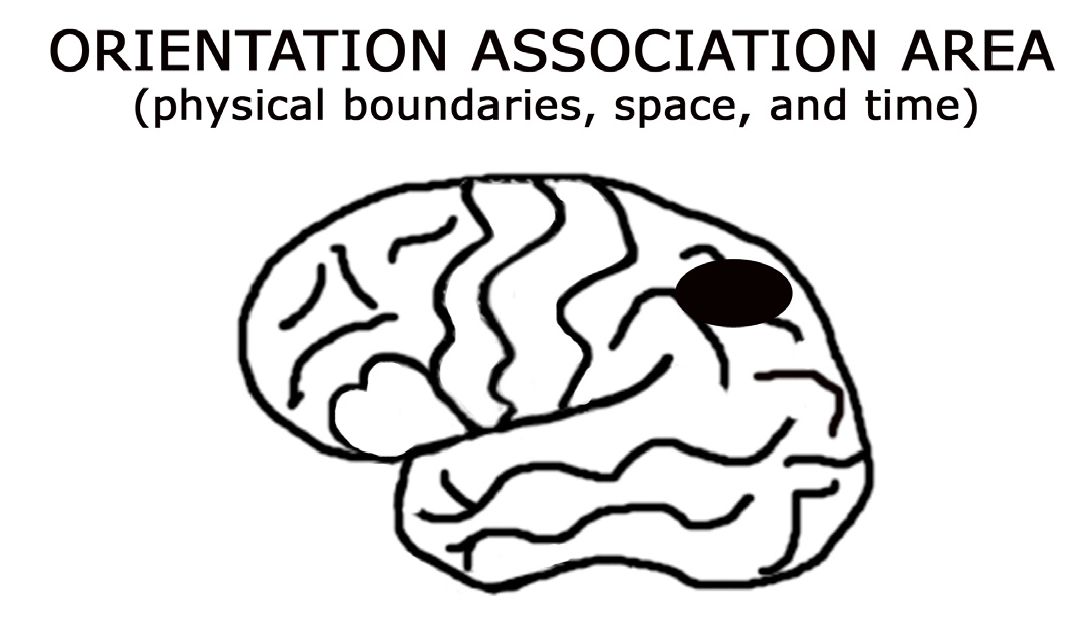
ORIENTATION ASSOCIATION AREA: Vùng liên hợp định hướng (physical boundaries, space, and time): (ranh giới vật lý, không gian và thời gian)
Thanks to this recent research, it makes good neurological sense that when my left language centers were silenced and my left orientation association area was interrupted from its normal sensory input, my consciousness shifted away from feeling like a solid, to a perception of myself as a fluid - at one with the universe.
[1]: Why God Won't Go Away (NY: Ballantine, 2001).